
Gio Ponti
Biography
Gio Ponti was born on 18 November 1891 in Milan, where he graduated in architecture in 1921. That same year he opened a studio with Emilio Lancia and Mino Fiocchi, joining the "Neoclassici" group. From those years date the house in Via Randaccio in Milan and Villa Bouilhet in Garches, Paris. In 1927 he founded « Il Labirinto » with Emilio Lancia, Tomaso Buzzi, Paolo Venini and Pietro Chiesa, a group producing avant-garde objects and furniture.
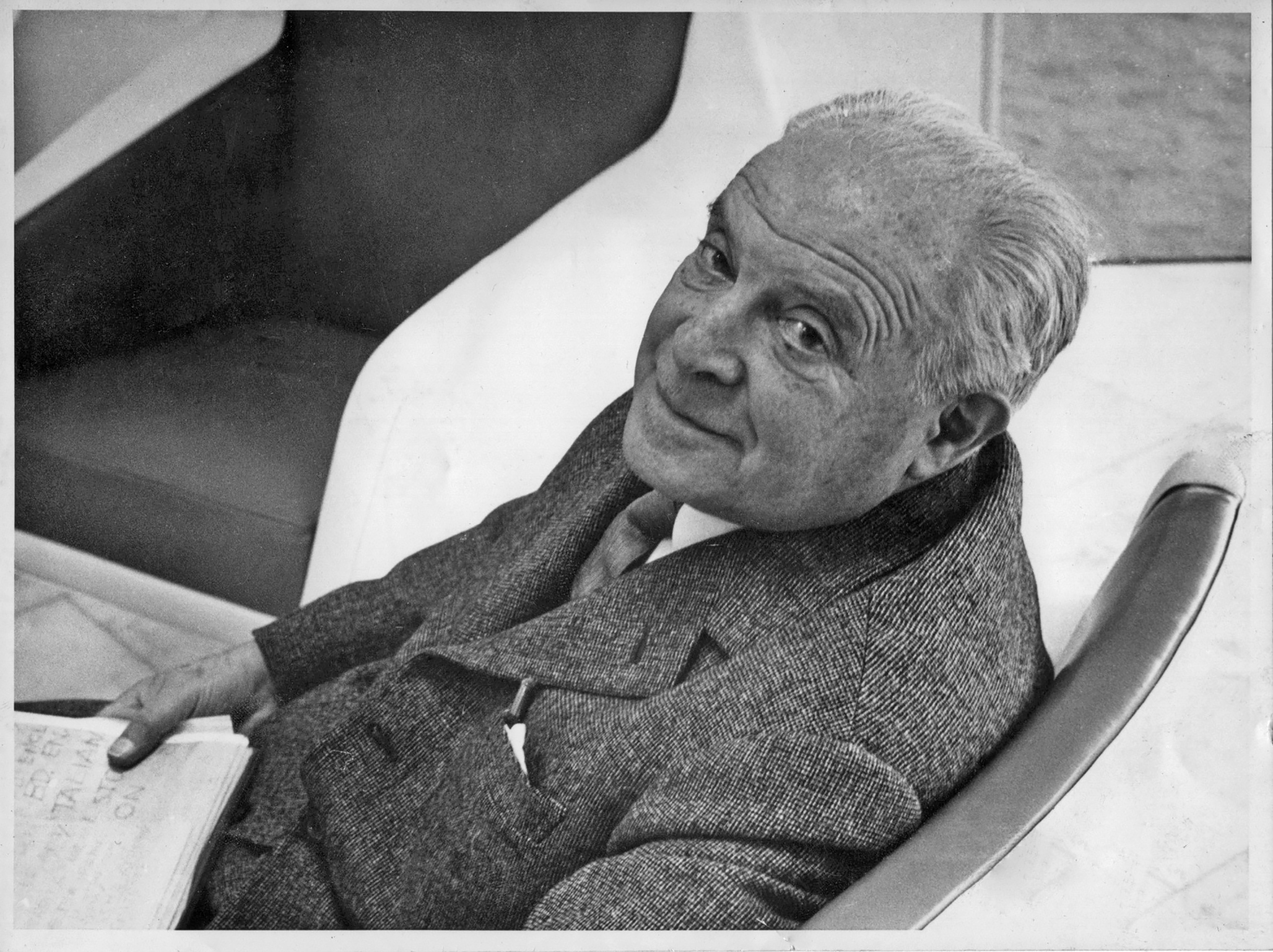
From 1923 to 1930 he was artistic director of Richard Ginori, for which he designed a collection of ceramics awarded at the 1925 Paris exhibition. At the same time he designed for Christofle, Krupp and Venini. In 1928 he founded the magazine Domus, which he would direct for the rest of his life, making it a vehicle for spreading new design ideas in architecture, furniture design and the decorative arts. From the late 1920s date the first « case tipiche » (typical houses), emblematically named « Domus », in which the idea of italianità (Italian character) meets an interest in rationalist theory.
In 1933, with the Casa Rasini on the Bastioni di Porta Venezia in Milan, his partnership with Emilio Lancia comes to an end. Worth noting in these years is his involvement in the Milan Triennials (1930, 1933, 1936, 1940 and 1951) and, with the Ponti-Fornaroli-Soncini studio until 1945: the Montecatini Building, the RAI Building, the Rectorate of the University of Padua, the Institute of Mathematics in Rome, Casa Marmont and Casa Laporte in Milan, Villa Donegani in Bordighera.
From 1936 he became a professor at the Faculty of Architecture of the Politecnico di Milano. In 1941 he founded the magazine Stile, which he directed until 1947, and in 1954 he devised the « Compasso d'Oro » award.
From the early 1950s, Ponti — in partnership with Antonio Fornaroli and Alberto Rosselli from 1952 — launched an extraordinary series of projects expressing the theory of « forma finita » (finished form): in furniture, with the « pareti organizzate » (organised walls: self-lit furniture units, furnished windows, dashboard-like panels); in design (among which we may recall the Leggera chair of 1951 and the Distex and Round armchairs of 1956…); and in architecture, with Villa Planchart and Villa Arreaza in Caracas and the Nemazee house in Tehran. 1956 saw the Pirelli Tower and 1957 the « Superleggera » chair.
In the 1960s, Ponti's attention turned to surfaces, colour and light, while continuing his work in design with the armchairs and sofas of the « Dezza » series, the « Novedra » armchair and the furniture of the « Serie Apta ». To these years belong, among others, the Hotel Parco dei Principi in Sorrento, the churches of San Francesco and San Carlo in Milan, the façade of the Bijenkorf department store in Eindhoven, the Netherlands, that of the INA Building in Via San Paolo in Milan, and the Pakistan House Hotel in Islamabad — leading, in the 1970s, to the Denver Art Museum in Colorado and Taranto Cathedral, where the treatment of surfaces intensifies to the point of dematerialisation, the architecture becoming a perforated sheet whose play of light, folds and transparencies dissolves its volumes.
Gio Ponti died in Milan on 16 September 1979, at the age of 87.
Critical note:
His work remains relevant today and should be understood and read in its entirety as a unified body, from his first works in the 1920s to his last in the 1970s.
The dynamic driving force of Ponti's work in fact lies not in the object created, but in its perception. This reversal of perspective, in which the viewer becomes the director, allows us to rest our gaze on the multifaceted reality of Ponti's landscapes.
These are landscapes in which we encounter art, proportion, colour and the most varied materials. Looked at closely — even in furnishings whose proportions are dictated by functionality — they reveal echoes of ancient forms that are part of our cultural heritage and traditions, or awaken in us archetypes that make them immediately familiar.
© Salvatore Licitra – 16 September 2026